Remote Job in Nigeria: Best Opportunities and How to Get Hired in 2026
There was a time when “I work from home” sounded suspicious in Nigeria. People would squint their eyes and ask, “You sure say this work legit?” But the idea that a “real job” requires a suit and an office is officially over. Many people are now skipping the morning rush and choosing to start a remote job in Nigeria instead.
By working from home, you can connect with global companies and earn in stronger currencies without leaving your living room. This is the new reality of the digital economy. You can live in any town, save money on transport, and finally have time to enjoy your life.
Whether you are a graduate or a professional, this guide breaks down the exact steps to land your first role and start earning from home.
What Is a Remote Job?
A remote job is simply a job you do from anywhere, your house, a café, workspace, or even your parents’ living room. Instead of showing up physically to an office, you work over the internet, communicate via tools like Slack, Zoom, or email, and submit your work digitally.
How Remote Jobs Work
Remote jobs work the same way traditional jobs do. You have tasks, deadlines, meetings, and a boss (or client). The only difference is location. You’re not sitting in the same building as your team. You’re connected via the internet.
Most remote workers use tools like:
- Communication: Slack, Zoom,Microsoft Teams, Google
- Project Management: Trello, Asana, Notion, ClickUp
- File Sharing: Google Drive, Dropbox, OneDrive
- Time Tracking(where required): Toggl, Clockify, Hubstaff
Some remote jobs are full-time with a fixed monthly salary. Others are contract-based, where you’re paid per project or per hour. Either way, the money hits your account, sometimes in dollars or pounds, without you leaving your street.
Difference Between Remote Jobs and Freelancing
People confuse these two all the time. Here’s a quick breakdown:
| Feature | Remote Job | Freelancing |
| Employment Type | Full-time or part-time employee | Self-employed contractor |
| Income Stability | Fixed monthly salary | Variable, project-to-project |
| Benefits (health, leave) | Sometimes included | Rarely included |
| Who You Work For | One employer | Multiple clients |
| Job Security | Higher | Lower |
| Flexibility | Moderate | Very high |
Both are valid paths. Some people start freelancing, then land a full-time remote role. Others switch between the two. The goal is to earn good money doing work you’re good at without a physical office tying you down.
Why Remote Jobs Are Becoming Popular in Nigeria
The remote work revolution didn’t start in Nigeria, but Nigerians have embraced it in a way that’s honestly impressive.
Here’s why the momentum keeps building.
Rising Cost of Living
Let’s call it what it is. Nigeria is expensive right now. The naira has taken some serious hits, fuel prices are painful, and rents in cities like Lagos and Abuja are climbing. When you can earn in dollars or pounds and spend in naira, your purchasing power jumps dramatically.
A Nigerian earning $1,000/month remotely is doing very comfortably by local standards. The math just makes sense.
Global Companies Hiring Nigerians
This is arguably the biggest shift of the last five years. Companies in the US, UK, Canada, and Europe have realized something important: talented workers in Nigeria are often just as skilled as local hires but significantly more affordable.
That’s a win for them, and a win for you.
Tech firms, content agencies, marketing companies, and startups are actively recruiting Nigerians on platforms like LinkedIn, Toptal, and Deel.
The barrier to entry isn’t nationality. It’s a skill.
Flexible Work Opportunities
98% of remote workers would work remotely for the entirety of their careers and actively recommend remote working options to others.
The flexibility of remote work appeals to almost everyone. Students can work between lectures. Parents can be present for their children. Night owls can work at midnight if they want to.
This kind of freedom is rare in traditional Nigerian work culture, and once people taste it, going back to the office feels like a downgrade.

Best Remote Job Opportunities in Nigeria
Now we get to the good stuff. Here are the top remote job categories that Nigerians are actively getting hired for right now.
Virtual Assistant Jobs
Virtual assistants (VAs) help business owners, executives, and entrepreneurs manage their workload remotely. Tasks can include managing emails, scheduling appointments, researching topics, data entry, customer communication, and more.
Average pay: $5 to $25/hour depending on experience
Good for: Organized, detail-oriented people who are great communicators
Customer Support Jobs
Companies with global customers need support agents available around the clock. Nigerian professionals are filling those slots, answering emails, resolving complaints, handling live chat, and guiding users through products.
Average pay: $400 to $1,200/month (full-time)
Good for: Patient, empathetic communicators
Content Writing Jobs
If you can write clearly and compellingly, there’s a massive market waiting for you. Blogs, websites, newsletters, product descriptions, white papers, businesses need words constantly.
Average pay: $0.05 to $0.20 per word (or $15 to $80/article depending on niche and experience)
Good for: Natural writers who enjoy research
Social Media Management
Every brand wants a strong social media presence. Few know how to achieve it. If you understand how Instagram, Twitter/X, TikTok, LinkedIn, or Facebook work and can create content that gets engagement, you’re in demand.
Average pay: $300 to $2,000/month per client
Good for: Creative, trend-aware people who live on social media anyway
Graphic Design Jobs
Visual content rules the internet. Logo design, social media graphics, marketing materials, UI mockups, businesses constantly need fresh visuals. Tools like Canva, Adobe Illustrator, and Figma are the playground.
Average pay: $500 to $3,000+/month depending on skill level and clients
Good for: Creative types with an eye for aesthetics
Software Development Jobs
This is the highest-earning remote category globally, and Nigeria has a growing, talented developer community. Frontend, backend, full-stack, mobile development, if you can code, the world is genuinely your oyster.
Average pay: $1,500 to $8,000+/month
Good for: People who enjoy problem-solving and can think logically
Digital Marketing Jobs
SEO, paid ads, email marketing, affiliate marketing, funnel building, digital marketing is the engine behind every online business. Skilled digital marketers who can show results are never out of work.
Average pay: $500 to $4,000/month depending on specialization
Good for: Data-driven, analytical minds who enjoy strategy
Data Entry Jobs
Entry-level, straightforward, and accessible. Data entry involves inputting, organizing, and managing information. No specialized skill set required beyond accuracy and speed.
Average pay: $200 to $600/month
Good for: Beginners looking to break into remote work
Skills You Need to Get a Remote Job in Nigeria
The good news is you don’t need a first-class degree or ten years of experience to get a remote job. You need skills, and most of them can be learned online for free or cheaply.
Communication Skills
Remote work lives and dies by communication. You won’t have the luxury of tapping someone on the shoulder to explain yourself. You need to write clearly, respond promptly, and express ideas with precision via text, email, and video calls.
Time Management
Nobody is standing over your shoulder. You set your own schedule (within client expectations), and if you can’t manage your time, your work suffers. Discipline is the remote worker’s superpower.
Tech and Digital Skills
At minimum, you need to be comfortable with email, Google Workspace (Docs, Sheets, Drive), video conferencing tools, and basic internet navigation. Beyond that, each job has its own tools. Learn the ones relevant to your field.
Problem-Solving Skills
Employers love people who bring solutions, not just problems. Remote workers who can troubleshoot independently, make smart decisions without constant supervision, and adapt quickly are the ones who last.
Top Platforms to Find Remote Jobs in Nigeria
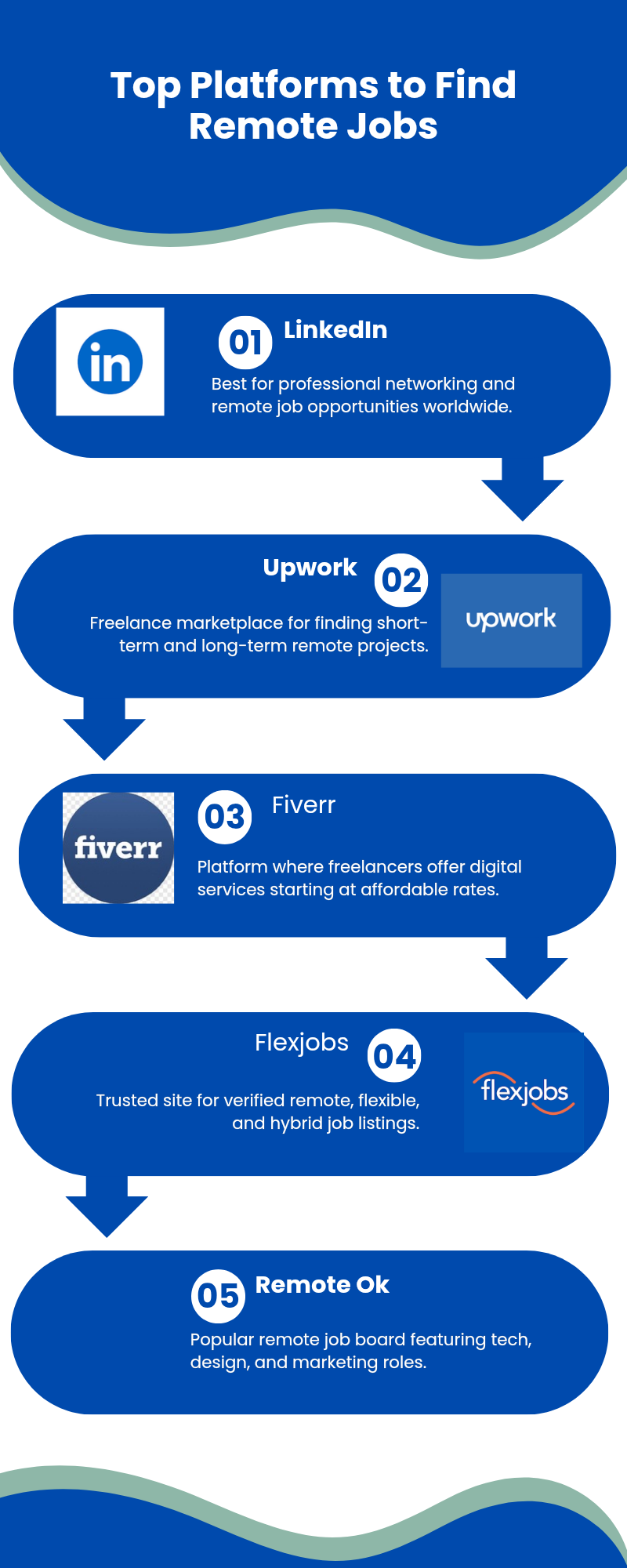
The world’s largest professional network has become an incredible remote job board. Set your job preferences to “Remote,” search your desired role, and start applying. Also, an optimized profile will bring recruiters to you.
Upwork
One of the biggest freelancing platforms globally. You create a profile, pitch for contracts, and build a portfolio of client reviews. Great for writers, designers, developers, VAs, and marketers.
Fiverr
Fiverr flips the script. Instead of applying for jobs, you create “gigs” (services you offer) and clients come to you. Best for creatives, writers, voice actors, and designers.
FlexJobs
A premium job board focused exclusively on remote and flexible work. It screens out scam listings, making it one of the more trustworthy platforms. Costs a small subscription fee but worth it.
Remote OK
A clean, no-nonsense remote job board updated daily. You can filter by category, engineering, design, marketing, support, writing. Free to use.
We Work Remotely
One of the largest remote-only job boards, with listings from reputable global companies. Strong in tech but has listings across multiple categories.
How to Apply for a Remote Job Successfully
Getting employers to notice you takes more than clicking “apply.” Here’s how to actually stand out.
Create a Professional CV
- Tailor your CV to remote work.
- Highlight any tools you’re proficient with (Slack, Notion, Trello, Zoom),
- mention previous remote or online work experience, and keep it clean, readable, and one to two pages maximum.
Build an Online Portfolio
This is your proof of work. Writers need a blog or published articles. Designers need a Behance or personal site. Developers need a GitHub. Whatever your field, show, don’t just tell.
Optimize Your LinkedIn Profile
A LinkedIn profile with a professional photo, a strong headline, detailed experience, and relevant skills significantly increases visibility. Turn on “Open to Work” and set it to remote opportunities.
Write a Strong Cover Letter
Many applicants skip this step. Don’t.
A well-written cover letter that speaks directly to the role, explains why you’re the right fit, and shows genuine interest in the company will always put you ahead of generic applications.
Common Remote Job Scams in Nigeria and How to Avoid Them

This section matters. Scammers prey on job seekers, and remote job seekers are a favorite target.
Know the signs.
Suspicious Job Charges: Any “employer” asking you to pay a registration, training, or onboarding fee before you start work.
Legitimate companies do not charge you to hire you. If someone asks for money before you’ve done any work, walk away.
Unrealistic Salary Promises
“Earn ₦500,000 weekly with no experience doing simple tasks!” Sound familiar? If the pay sounds wildly better than any comparable job on earth, it’s a scam designed to take your attention and eventually your money.
Suspicious Telegram or WhatsApp Recruiters
Legitimate companies recruit via official email addresses and platforms like LinkedIn or company career pages. If your “recruiter” only communicates via WhatsApp or Telegram, refuses to get on a video call, and can’t provide verifiable company information, that’s a major red flag.
Challenges Nigerians Face With Remote Jobs
Remote work in Nigeria comes with real obstacles that deserve honest discussion.
Poor Internet Connection
Unstable internet is the number one complaint. Dropped Zoom calls, slow file uploads, and unreliable connectivity can seriously affect your work quality and reputation. Investing in a good internet provider and a backup (like a MiFi or second SIM) is practically non-negotiable.
Power Supply Issues
The electricity situation is a real challenge. Generators cost money to run, and working during outages disrupts your schedule. A power bank, inverter, or solar setup has become a standard investment for serious remote workers.
Payment Limitations
Receiving international payments in Nigeria has historically been complicated. Services like PayPal have limited functionality here, but alternatives like Payoneer, Wise (TransferWise), Grey, and Geegpay have stepped in to fill the gap.
Most remote workers in Nigeria use these platforms successfully.
How Much Can You Earn From a Remote Job in Nigeria?
Remote job earnings can vary widely depending on your skill, experience, and the type of work you do, but the earning potential is very high.
| Job Role | Monthly Earning (Beginner) |
| Data Entry | $150 to $400 |
| Customer Support | $300 to $600 |
| Content Writing | $200 to $500 |
| Virtual Assistant | $300 to $700 |
| Social Media Mananger | $300 to $700 |
High-Income Remote Careers
| Job Role | Monthly Earnings (Experienced) |
| Software Developer | $2,000 – $8,000+ |
| Digital Marketing Specialist | $1,000 – $4,000 |
| UX/UI Designer | $1,500 – $5,000 |
| Data Analyst | $1,500 – $4,000 |
| Product Manager | $2,500 – $7,000+ |
The gap between beginner and experienced income is massive, and the timeline to close that gap is entirely in your hands.
Best Remote Jobs in Nigeria for Students
Being a student doesn’t mean you have to be broke.
These roles are flexible enough to fit around your lecture schedule.
Part-Time Writing Jobs
Many blogs and marketing agencies hire part-time writers. You can write in your free time, choose how much work you want, and earn steady income. For example, writing five $15 articles weekly can earn you about $300 per month, even as a student.
Online Tutoring
If you’re strong in any subject, maths, sciences, English, coding, IELTS prep, tutoring is one of the most natural side incomes available. Platforms like Preply, Chegg, and TutorMe connect tutors with students worldwide.
Social Media Assistance
Small businesses everywhere need help managing their social media and often can’t afford a full-time agency. A student who understands Instagram or TikTok well can offer this as a part-time service and earn handsomely for it.
Frequently Asked Questions About Remote Jobs in Nigeria
Can I Get a Remote Job With No Experience?
Yes, absolutely. Roles like data entry, customer support, and basic virtual assistant work often hire entry-level candidates. The key is to learn a skill, build even a small portfolio, and apply consistently. Everyone starts somewhere.
Which Remote Job Pays the Most?
Software development consistently tops the list, with experienced developers earning $5,000 to $10,000/month. Digital marketing, UX design, and product management also command high salaries with experience.
Are Remote Jobs Legit in Nigeria?
Completely. Thousands of Nigerians earn their full income from legitimate remote jobs with international companies. The key is finding them through reputable platforms (LinkedIn, Upwork, FlexJobs) and being vigilant about scams.
Do I Need a Laptop for Remote Work?
In almost all cases, yes. A reliable laptop is the primary tool of a remote worker. You don’t need anything fancy to start, a mid-range laptop with a stable internet connection will handle most entry-level remote roles comfortably.
Final Thoughts on Getting a Remote Job in Nigeria
The remote work opportunity for Nigerians in 2026 is real, growing, and genuinely life-changing for those who take it seriously.
It’s not a get-rich-quick scheme. It’s not easy in the first few months. But for those who develop a real skill, build a credible presence online, and apply with consistency, the rewards are significant. We’re talking dollar income, time freedom, career growth, and the ability to work from literally anywhere.
Start with one skill. Build one portfolio. Apply to one job.
That’s literally how every successful remote worker in Nigeria started. The only real difference between them and someone who’s still dreaming about it? They started.